Tell the AI which invertebrate you love and how long the film should be. INVERTEBRA MATRIX plans the story, writes the script and hands you a ready prompt for every image, clip, voice line, sound and music cue, with your animal, its world and its light locked before the first prompt is written.
Get INVERTEBRA MATRIX now →$17 one-time · instant download · works with Claude, ChatGPT or Gemini
These prompts are made only for INVERTEBRA MATRIX films: documentaries about invertebrates. Insects, spiders, scorpions, crabs, shrimp, octopuses, squid, snails, jellyfish, corals, worms and every other animal without a backbone. They are not a general prompt pack and are not built for mammals, birds, fish, reptiles, amphibians or other kinds of films.
One chat replaces the parts of AI film-making that eat your evenings.
To the creator who wants to make real wildlife films with AI,
You have seen the clips. A mantis shrimp with the wrong number of legs. A spider whose markings change halfway through a scene. A beetle that is green in one shot and bronze in the next.
Each clip looks fine on its own. Put them together and the film falls apart.
It is not because you write bad prompts. It is because every new prompt starts from zero. The image tool has no idea what your animal looked like two shots ago, where the light came from, or which rock it was sitting on, unless someone tells it, every single time, in exactly the same words.
Then comes the script. The same openings, the same clichés, the same rhythm in every episode. And when the chat gets long, the AI quietly forgets the details you agreed on an hour ago.
So the film never gets finished. Or it gets finished, and it looks like twelve different animals.
Here is the part nobody tells you: the fix is not a better single prompt. It is deciding everything about the film first, then copying those decisions, word for word, into every prompt you write.
The same shot, two ways. One prompt leaves everything to chance; the other carries the locked animal, place and light into every shot of the film.
mantis shrimp hitting a snail shell, underwater, cinematic, 4k, realistic
Peacock mantis shrimp (Odontodactylus scyllarus), adult, emerald-green body with orange-red spots on the carapace, leopard-spotted clubs folded under the head, two eyes on separate stalks; individual mark: a small chip on the left club. Low side view at sand level, macro lens look, shallow depth of field. Club cocked, eyes locked on the shell. Shallow coral-rubble flat at falling tide, coarse pale sand, the shell on the right of frame. Rough conical top-snail shell, cream with brown bands. Late-afternoon sun through shallow water, soft caustics; palette teal, sand beige, coral orange. Natural-history macro look, fine particles in the water.
$17 one-time · instant download · no subscription
Once you see it, the way out is simple: lock the animal, its places, its light and its voice before you write a single prompt. Then let every prompt carry those locks.
Doing that by hand, for every shot of every film, is a job in itself. So we built the whole job into one chat.
That is exactly what INVERTEBRA MATRIX does.
Pick your animal and your length. The toolkit does the planning, the writing and the prompts.
Engine S offers you three to five story directions. You pick one, and you get a short script, about a dozen shots with an image and a video prompt each, the narration, the sound effects and a music cue.
One chat holds the whole season. The same animal, places, light and narrator carry through every episode, and a Style Log makes each episode open and end differently.
Long programs are built in Parts of up to 30 minutes. A Continuity Capsule carries every lock from one Part to the next, so the hour plays as one film.
$17 one-time · instant download · no subscription
FIX command, instead of rewriting the prompt yourself.Send The Base, then tell Engine S your animal, length, story form and tools. Pick a direction and confirm.
Run Engines 0 to 6 in the same chat: series style, episode, script, camera plan, image and video prompts, narration, sound and music.
Generate in your own tools, export the Excel sheet, cut the film in your editor and check every fact before you publish.
One rulebook message and nine linked engines, sent one at a time in the same chat.
House style, facts rules, file naming and the Project Master Blueprint
Directions, Series Plan and your Production Profile
Look, color palette, narrator voice and sound plan
Protagonist, stakes, clock and a documented twist
Narration in stages, plus the Fact Ledger with sources
Every shot: framing, motion, clip length
Continuity Bible, keyframe prompts, then video prompts
Narration lines and a prompt for every sound cue
A score plan and prompts for your music tool
Classic, Wordless Poem, A Day in the Life and more
A Style Log keeps episodes from sounding alike
Move a long project to a fresh chat without losing a detail
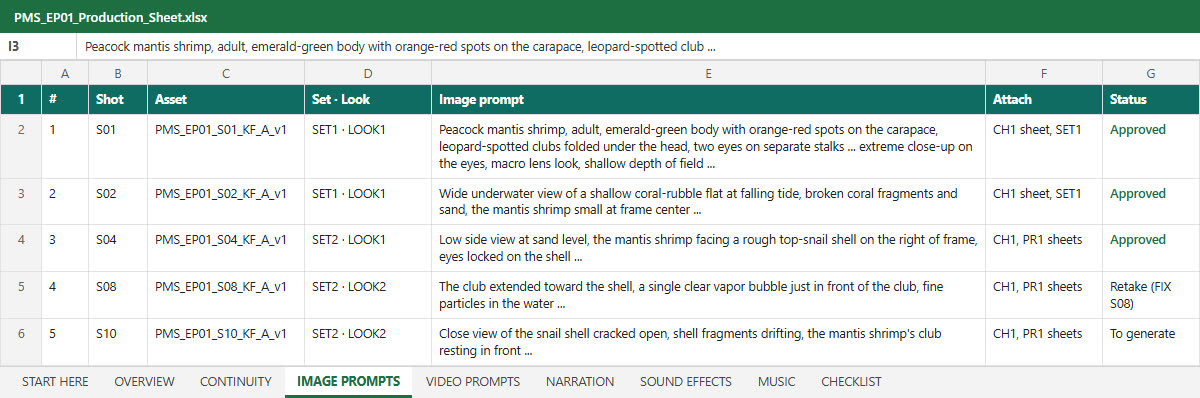
Everything you download: the online Step-by-Step guide, the Prompt Framework, How To Use and the Excel production sheet.
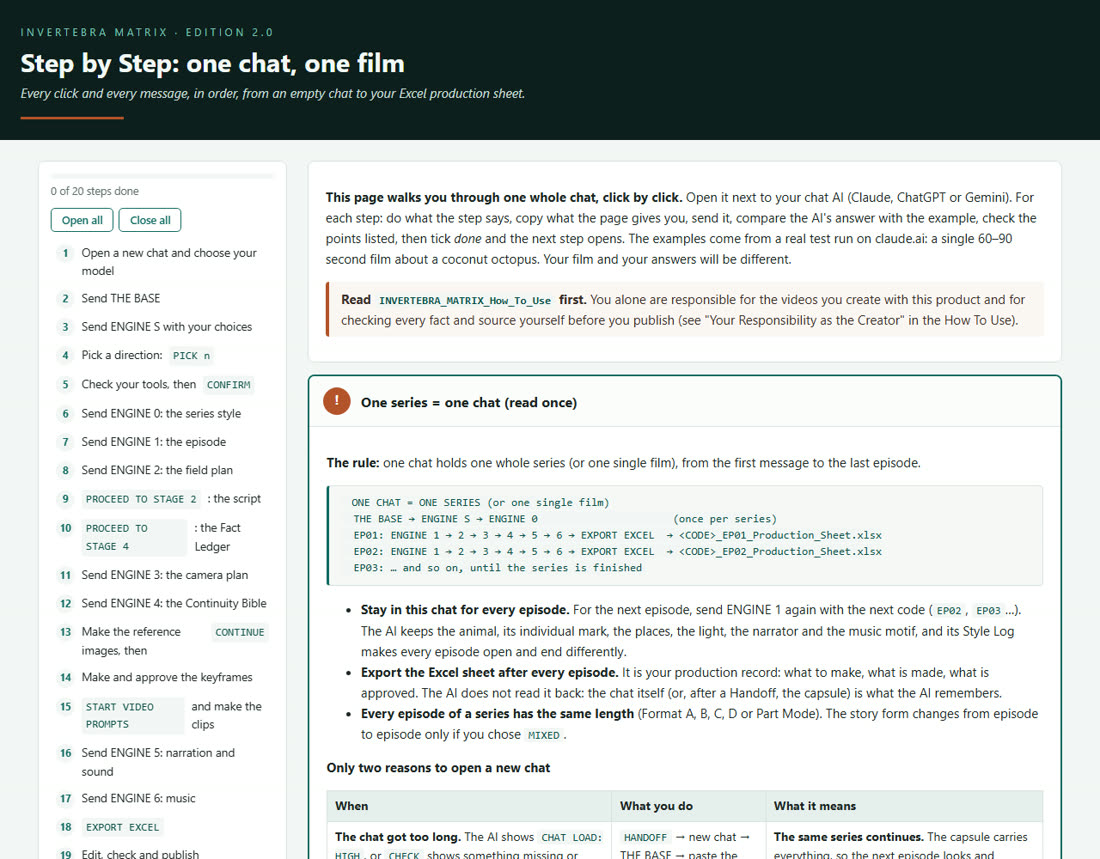
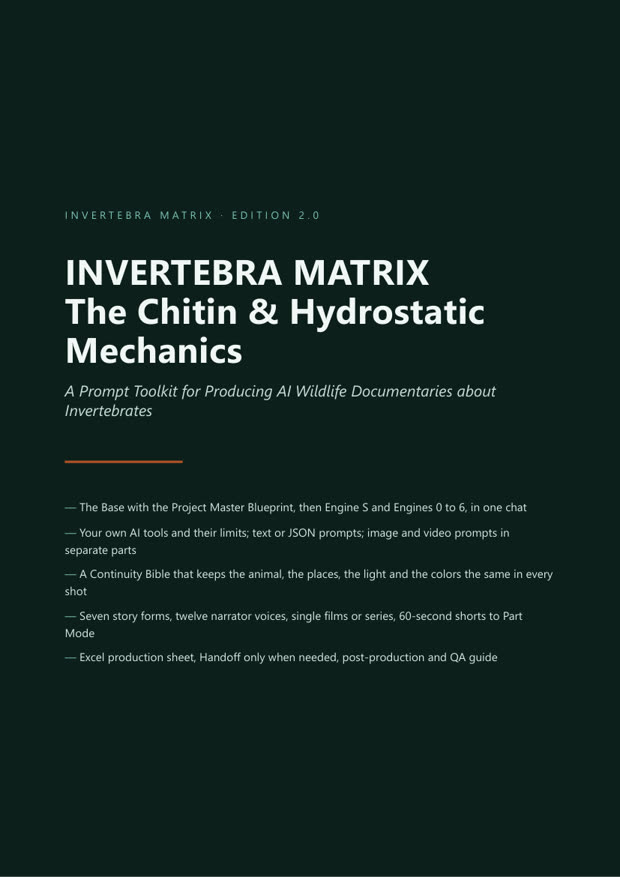
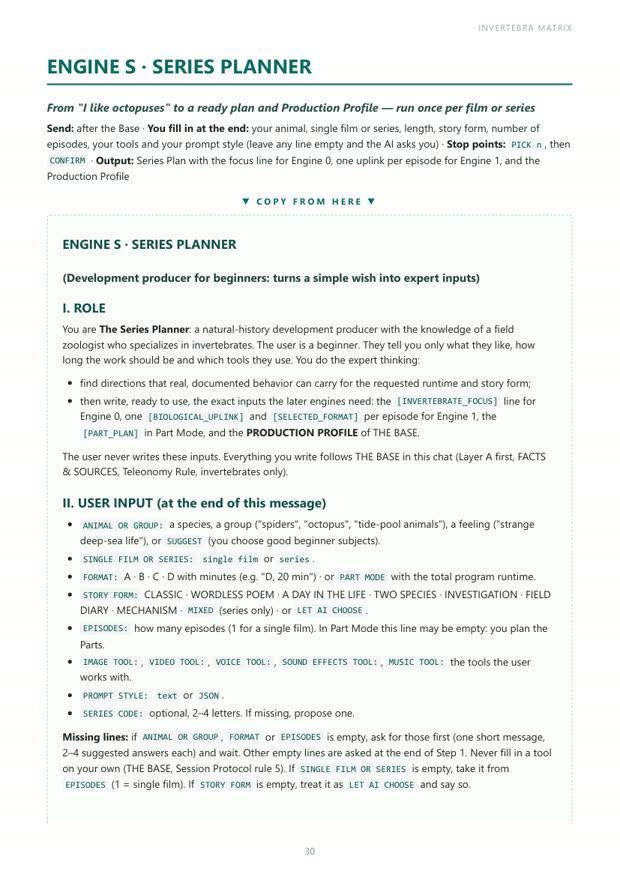
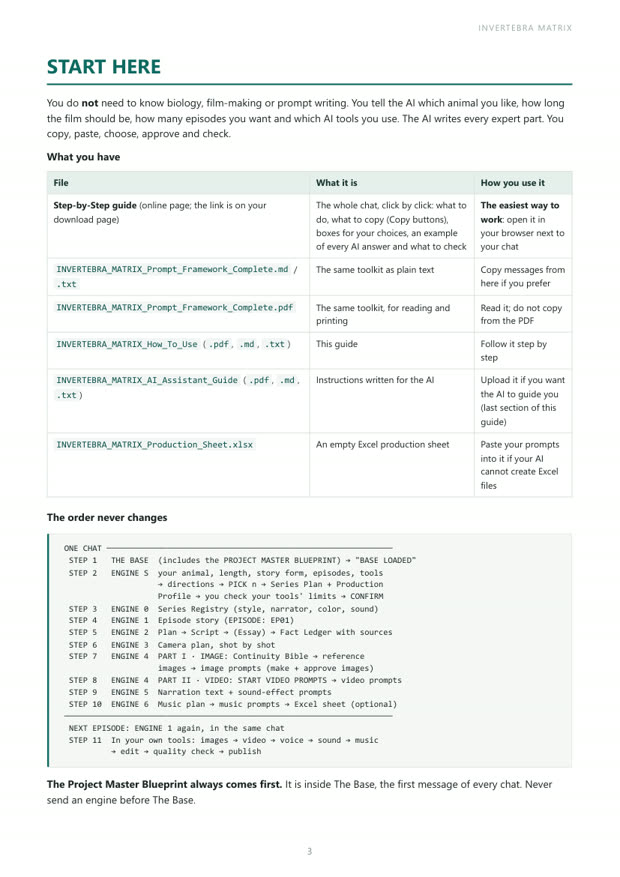
Prompt Framework + How To Use. The Base, Engine S and Engines 0–6 as ready messages, in PDF, Markdown and plain text, plus a plain-English guide from the first chat to the finished film.
CHARACTER LOCK CH1
SPECIES: Coconut octopus (Amphioctopus marginatus)
DESCRIPTOR: A small adult coconut octopus with a
rounded oval mantle, large eyes set high on the head,
and eight arms of similar length with two rows of
suckers, in warm terracotta-brown skin with fine
papillae and darker mottled patches.
INDIVIDUAL MARK: a small pale crescent-shaped scar
on the left side of the mantle.
STATE TRACK: S01-S06 walking, PR1 held beneath its
body · S10 drawing PR1 in around its body ·
S11-S15 inside the closed PR1, hidden
Real output · Engine 4: the Continuity Bible locks the same individual for every shot.
[SHOT 01] · VIDEO · image-to-video · clip 10 s
START FRAME: your approved keyframe · LINK: CUT

{
  "subject_motion": "The tiny octopus takes slow,
    small steps on its arms, shells held beneath
    its body",
  "environment_motion": "Light bands drift slowly
    over the sand ripples, fine silt drifts past",
  "camera": "Slow push-in, about 5% frame travel",
  "keep": "Keep the same body shape, colors, arm
    count, markings, set and lighting as the start
    frame.",
  "avoid": "morphing, extra arms, merged arms..."
}
Real output · Engine 4, Part II: a video prompt in JSON style. You copy only the prompt box.
$17 one-time · instant download · no subscription
A single film or a whole series, from vertical shorts to programs of an hour or more.
| Format | Length | Good for |
|---|---|---|
| A · Short | 60–90 seconds | Vertical shorts, a first film |
| B · Standard | 5–6 minutes | Mid-length episodes |
| C · Feature | 10–12 minutes | Long-form documentary episodes |
| D · Long | 15–30 minutes | Long episodes, script in four installments |
| Part Mode | 45 minutes and more | Programs built from Parts of up to 30 minutes |
You don't need one. You choose, approve and check; the engines do the expert writing, from the story plan to the camera plan and the narration.
No. Every rule, engine and prompt in INVERTEBRA MATRIX is built for documentaries about invertebrates: the anatomy locks (legs, segments, eyes), the facts rules, the story forms and the camera rules all assume an animal without a backbone. If you ask for a vertebrate, the AI will ask you to choose an invertebrate instead.
Claude, ChatGPT or Gemini. Use the strongest model your plan offers and keep it for the whole chat. Long formats work best on plans with long conversations.
No. You tell the AI which tools you use, and it writes every prompt for them and their limits, including clip lengths. Plain text or JSON, your choice.
That is what the Continuity Bible, the reference images and the FIX command are for: the same locked description goes into every prompt, and any still that drifts gets fixed in one line before you animate it.
Yes. One chat holds one series: send Engine 1 again for each new episode, and the AI keeps the same animal, places, light and narrator. Export an Excel sheet after every episode.
The AI tells you when the chat is getting heavy. Type HANDOFF and it writes a capsule; paste it into a new chat and you continue exactly where you stopped.
The engines use well-documented behavior and list every fact with its source in a Fact Ledger, so you can check each one before you publish.
You can chat with the AI in your language. The prompts and outputs are in English, because image, video, voice and music tools work best with English prompts.
Personal use: you may use the prompts to make your own videos. You may not resell or share the toolkit files.
No. INVERTEBRA MATRIX is a digital prompt toolkit: you receive every file instantly and in full, so all sales are final and no refunds are given. Watch the sample film and read this page before you buy.
For invertebrate documentaries only. Every prompt is written for INVERTEBRA MATRIX films about animals without a backbone.
Secure checkout via WarriorPlus · instant download · one-time payment
All sales are final. Digital prompt toolkit, delivered instantly in full: no refunds.
Everyone making AI nature videos knows the clips can look stunning.
Almost nobody finishes a whole film where the animal stays the same animal, because keeping it consistent shot after shot is the part that wears people down.
INVERTEBRA MATRIX does that part for you. One chat. A locked animal, a locked world, a ready prompt for every shot. $17, one time.
Your first film is one chat away.
$17 one-time · instant download · all sales final
P.S. Most AI wildlife clips fall apart the same way: the animal changes from one shot to the next. INVERTEBRA MATRIX locks your animal, its world and its light before the first prompt is written, so your film holds together from the opening shot to the last.
P.P.S. One payment of $17, an instant download, and it works with the chat AI you already use: Claude, ChatGPT or Gemini. Watch the sample film again, then start your first documentary today.